Why real progress often begins when we stop looking for a single perfect answer.
“We’ve found it.”
The solution.
The mechanism.
The technology that will change everything.
It is a story that seems to repeat itself over and over again.
A promising discovery appears.
The first results are impressive.
Experts become enthusiastic.
Investors step in.
Millions — sometimes billions — flow into the new field.
And slowly, a feeling emerges that we have finally found the missing piece of the puzzle.
Until reality turns out to be far more complex.
Perhaps that is one of the most fascinating aspects of innovation.
Not that we keep chasing the wrong ideas.
But that complex problems rarely yield to a single elegant answer.
From aging research to AI
In longevity research, we have seen several waves emerge over the past decades.
First, telomeres were considered the key to healthy aging.
Then attention shifted to so-called “zombie cells,” or senescent cells, believed to drive inflammation and age-related decline.
Today, cellular reprogramming has become the new promise. The idea that cells can be reset to a younger state captures the imagination of scientists, investors, and entrepreneurs alike.
Does that mean previous theories were wrong?
Not necessarily.
They simply turned out to be incomplete.
And perhaps the same applies to far more domains than we realize.
Functional Food: from fat to sugar to superfoods
The same pattern can be seen in nutrition.
For years, fat was considered the enemy.
Then sugar took center stage.
After that came antioxidants, superfoods, probiotics, keto diets, intermittent fasting, microbiomes, and personalized nutrition.
Each new wave brought hope and valuable insights.
Yet health ultimately proved to be much more than the sum of a single ingredient.
Nutrition, exercise, sleep, stress, genetics, behavior, and social context all interact within a complex system.
The deeper we look, the clearer it becomes that there is no magic nutrient.

AI is more than a model
Artificial intelligence seems to be following a similar path.
From machine learning to deep learning, and from generative AI to large language models, the technological progress has been extraordinary.
Yet many organizations quickly discover that their biggest challenges do not lie within the models themselves.
They lie in data.
Processes.
Expectations.
Adoption.
Governance.
And above all, people.
Technology can accelerate change.
But coherence does not emerge automatically.
It grows through experience, collaboration, context, and the ability to connect different innovations into a meaningful whole.
Perhaps that remains one of the most human qualities of all.
Why the Einstein Telescope comes to mind
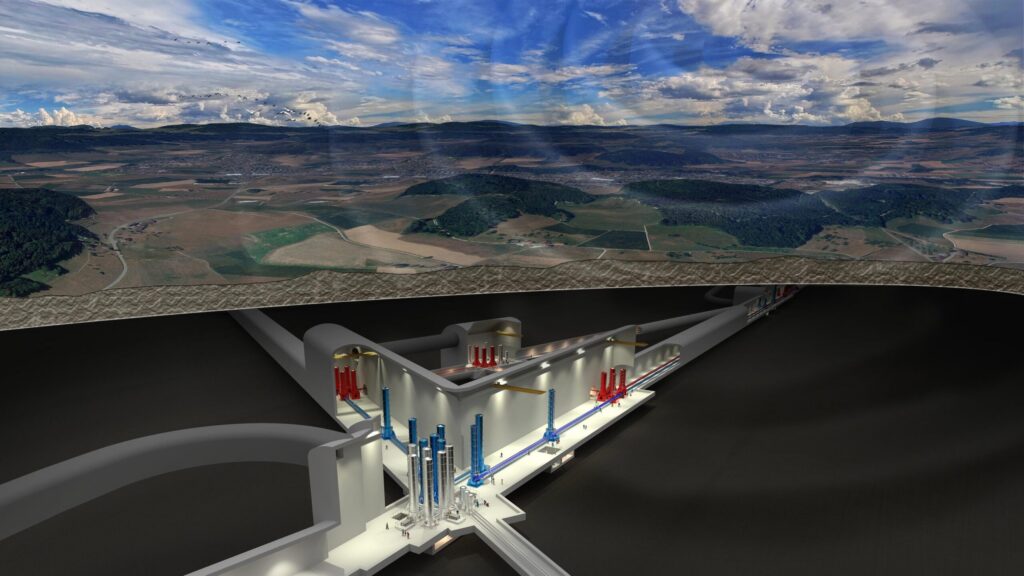
That is perhaps why I find the story of the Einstein Telescope so fascinating.
From a distance, it sounds deceptively simple.
Build a detector and measure gravitational waves.
But behind that apparent simplicity lies an almost overwhelming level of complexity.
- Ground vibrations.
- Temperature fluctuations.
- Vacuum systems.
- Software.
- Materials.
- Reliability over decades.
- International collaboration.
Even factors entirely outside the project itself — tiny earthquakes or vibrations caused by human activities hundreds of kilometers away — can influence the outcome.
There is no magical component.
The power lies in the interactions between all these elements.
Batteries are systems too
The same applies to e-mobility.
For years, battery capacity seemed to be the ultimate measure of performance.
Bigger was better.
Today, we know that performance depends on much more than kilowatt-hours alone.
- Thermal management.
- Software.
- Charging strategies.
- Safety.
- Degradation.
- Usage profiles.
- Grid integration.
There is no perfect battery.
Only solutions that work optimally within a specific system.

Perhaps we like simple answers too much
What continues to strike me across very different industries is our deeply human tendency to reduce complexity to a single answer.
One ingredient.
One technology.
One methodology.
One component.
One model.
As if somewhere there must be a hidden button that solves everything.
But reality pays little attention to our desire for simplicity.
Quite the opposite.
The deeper we look, the more relationships, interactions, and dependencies begin to reveal themselves. What first appears to be an isolated problem often turns out to be part of something much larger.
Perhaps that is the paradox of progress.
Not that we keep finding simpler answers.
But that we gradually learn to understand how different elements influence one another.
And that is precisely why it is so fascinating to discover similarities between worlds that seem unrelated at first glance.
A researcher studying aging.
An engineer working on the Einstein Telescope.
Someone developing new food products.
An AI specialist.
Their expertise may be very different. But in the end, they are all trying to do the same thing.
Not to find one magical solution.
But to understand how a complex system actually works.
Because real progress rarely comes from a single brilliant discovery.
It emerges when we begin to see connections.
When we bring different perspectives together.
And when we accept that the most interesting answers are often found somewhere between disciplines.