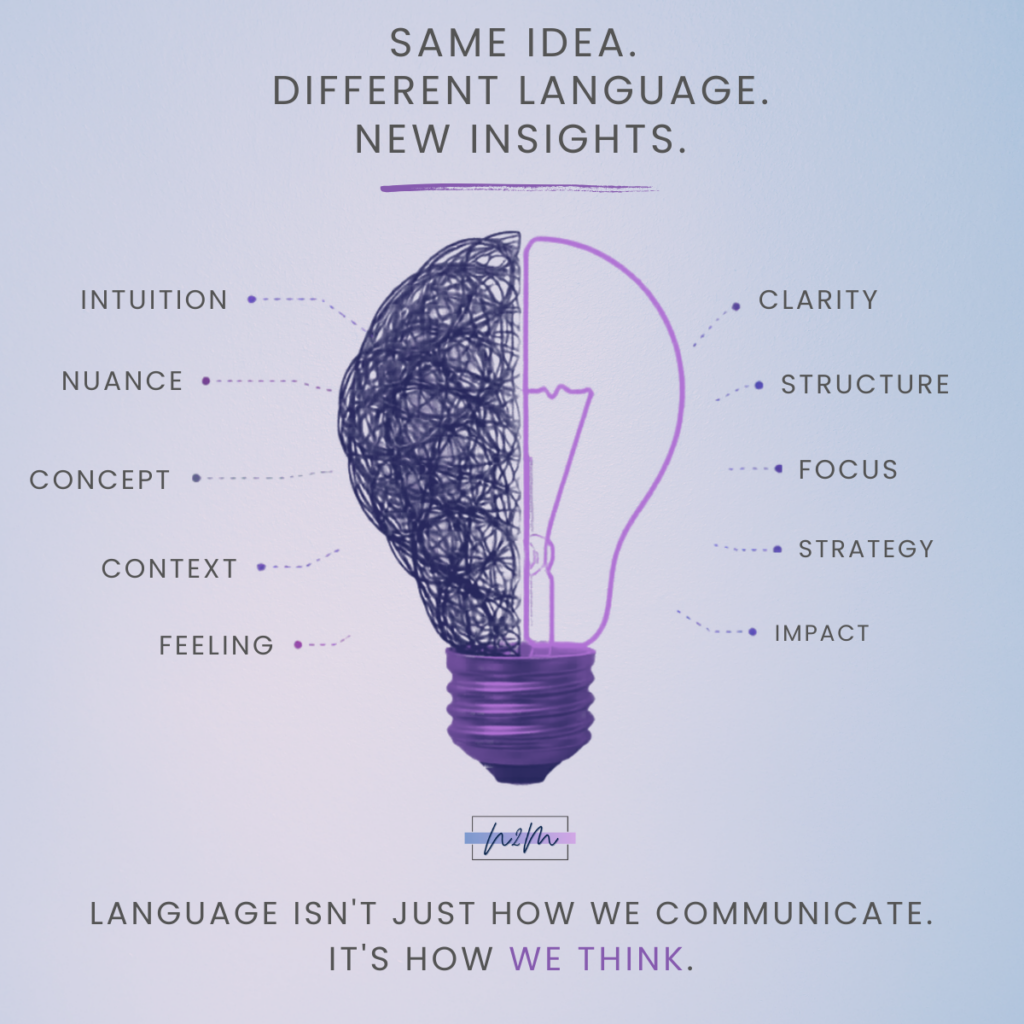
The more I work with innovation, strategy and complex ideas, the more I notice how strongly language influences the way ideas evolve.
When an idea gets stuck, our first instinct is often to look for an external solution.
We look for an expert, a consultant, a coach or a sparring partner to help us move forward.
And sometimes that is exactly what is needed.
But sometimes something much simpler happens.
Sometimes an idea changes simply because we change the language in which we think about it.
Not because the idea itself changes.
But because every language organizes meaning differently.
What feels abstract in one language can suddenly become much more tangible in another.
An emotionally charged topic may create distance and become easier to analyze.
A technical concept may become simpler.
An ambitious plan may become more realistic — or, sometimes, even bigger.
I notice this not only in my own thinking.
In multilingual teams, I regularly see the same discussion take a different direction depending on the language being spoken.
Not because people mean different things.
But because language naturally emphasizes certain nuances while pushing others into the background.
As a result, new connections emerge, different interpretations become possible, and insights that previously remained hidden can suddenly come into view.
Perhaps language is more than a communication tool.
Perhaps it is also a thinking tool.
A way to shift perspective.
A way to reveal hidden layers within an idea.
After all, many breakthroughs do not happen because someone suddenly invents a completely new idea.
They happen because someone looks at the same idea from a different angle.
If you ever feel stuck on an idea, try explaining it again.
In another language.
In a dialect.
To a child.
To a customer.
Or ask someone else to summarize your idea in their own words.
Very often, the next layer of the idea is already there.
It is simply waiting for a different language, perspective or interpretation to bring it into view.
And that is often where the most interesting form of strategic sparring begins for me:
not searching for new ideas, but discovering new ways of looking at the ideas that already exist.